

Month-end reconciliation consumes 30% of finance teams' time, and most of that effort goes into chasing down errors, verifying transactions, and preparing for audits. For mid-market finance leaders, inefficient audit processes translate to delayed reporting, compliance risks, and decision-making based on questionable data. This guide walks you through a systematic approach to prepare, execute, and verify operations data audits that enhance accuracy, accelerate your close, and build confidence in your financial reporting. You'll discover how to identify risks early, automate reconciliations, and leverage technology to transform audit readiness from a quarterly scramble into a continuous, controlled process.
Table of Contents
- Understanding The Problem: Audit Challenges And Risks
- Preparing For Your Operations Data Audit: What You Need
- Executing The Audit: Step-By-Step Operations Data Audit Process
- Verifying And Closing The Audit: Review, Reporting, And Follow-Up
- Transform Your Audit Process With Lole Works
Key takeaways
| Point | Details |
|---|---|
| Operations data audits improve accuracy | Systematic audits reduce reporting errors and strengthen financial controls across your organization. |
| Preparation accelerates readiness | Standardized checklists and governance frameworks cut audit preparation time and eliminate last-minute scrambles. |
| Automation minimizes risk | AI-powered reconciliation and embedded controls reduce manual rework and catch errors before auditors arrive. |
| Mock audits identify issues early | Pre-audit reviews uncover up to 80% of problems, ensuring smoother official audits and fewer surprises. |
Understanding the problem: audit challenges and risks
Mid-market finance teams face recurring audit challenges that slow reporting and expose the business to financial risk. Data errors, reconciliation delays, and weak internal controls create a perfect storm of inefficiency. When your team spends weeks reconstructing transactions and hunting for supporting documentation, you're not just wasting time. You're introducing opportunities for mistakes that auditors will flag.
Human error accounts for 41% of inaccurate numbers in financial reporting. That statistic should alarm any CFO. Manual data entry, spreadsheet formulas gone wrong, and inconsistent processes compound over time. By the time auditors review your books, those small errors have snowballed into material deficiencies. In 2024, 39% of inspected audits contained material deficiencies, a clear signal that traditional audit preparation methods aren't working.
Poor controls amplify these risks. Organizations face exposure due to weak internal controls, leaving gaps that auditors exploit during fieldwork. Without clear segregation of duties, approval workflows, or system-generated audit trails, your team scrambles to prove transactions were authorized and recorded correctly. This reactive approach wastes resources and invites qualified opinions that damage stakeholder confidence.
Common audit pain points include:
- Reconciliation delays caused by disconnected systems and manual processes
- Missing or incomplete documentation for accruals, leases, and debt transactions
- Inconsistent expense recognition across departments and entities
- Lack of real-time visibility into financial data, forcing month-end reconstruction
"Without orchestrated workflows and embedded controls, audits slow into manual reconstruction exercises that drain finance teams and delay critical reporting."
These challenges hit mid-market companies especially hard. You lack the resources of enterprise finance departments, yet investors and lenders demand the same level of rigor. Financial reporting automation challenges compound when legacy systems can't communicate, forcing your team to rely on spreadsheets and manual reconciliations that introduce errors at every step.
Preparing for your operations data audit: what you need
Effective audit preparation starts with establishing a single source of truth for your financial data. When your ERP, billing system, and operational databases don't align, reconciliation becomes a nightmare. You need integrated data infrastructure that consolidates information from all sources and maintains consistency across reports. This foundation eliminates the conflicting figures that plague mid-market finance teams.

Standardize your financial reporting formats and automate repetitive routines. Finance teams with standardized reporting and automated routines make faster decisions and maintain cleaner audit trails. When every department uses the same chart of accounts, expense categories, and reporting templates, you cut reconciliation time and reduce errors. Automation handles routine tasks like journal entries, accruals, and variance analysis, freeing your team to focus on exceptions and analysis.
Implement clear internal control frameworks before auditors arrive. Your controls should include:
- Segregation of duties for transaction approval and recording
- System-enforced approval workflows for purchases and payments
- Automated reconciliation checks that flag discrepancies in real time
- Regular access reviews to ensure only authorized users can modify financial data
Without orchestrated workflows, embedded controls, and system-generated audit trails, audits slow into manual reconstruction exercises. Your systems should automatically log who approved each transaction, when changes occurred, and what supporting documentation exists. This eliminates the scramble to prove compliance during fieldwork.
Prepare a comprehensive audit readiness checklist that covers:
| Category | Required Items |
|---|---|
| Financial statements | Trial balance, income statement, balance sheet, cash flow statement |
| Supporting schedules | Accounts receivable aging, inventory valuation, fixed asset register |
| Documentation | Contracts, invoices, purchase orders, bank statements |
| Control evidence | Approval logs, reconciliation sign-offs, access control reports |
Pro Tip: Schedule quarterly mini-audits throughout the year instead of waiting for year-end. This approach spreads the workload, catches issues early, and keeps your documentation current.
Data governance best practices ensure your audit preparation efforts stick. Establish clear ownership for data quality, define validation rules, and enforce standards across all systems. When everyone understands their role in maintaining accurate data, your audit readiness improves dramatically. Data governance services can accelerate this transformation by implementing frameworks tailored to mid-market finance environments.
Executing the audit: step-by-step operations data audit process
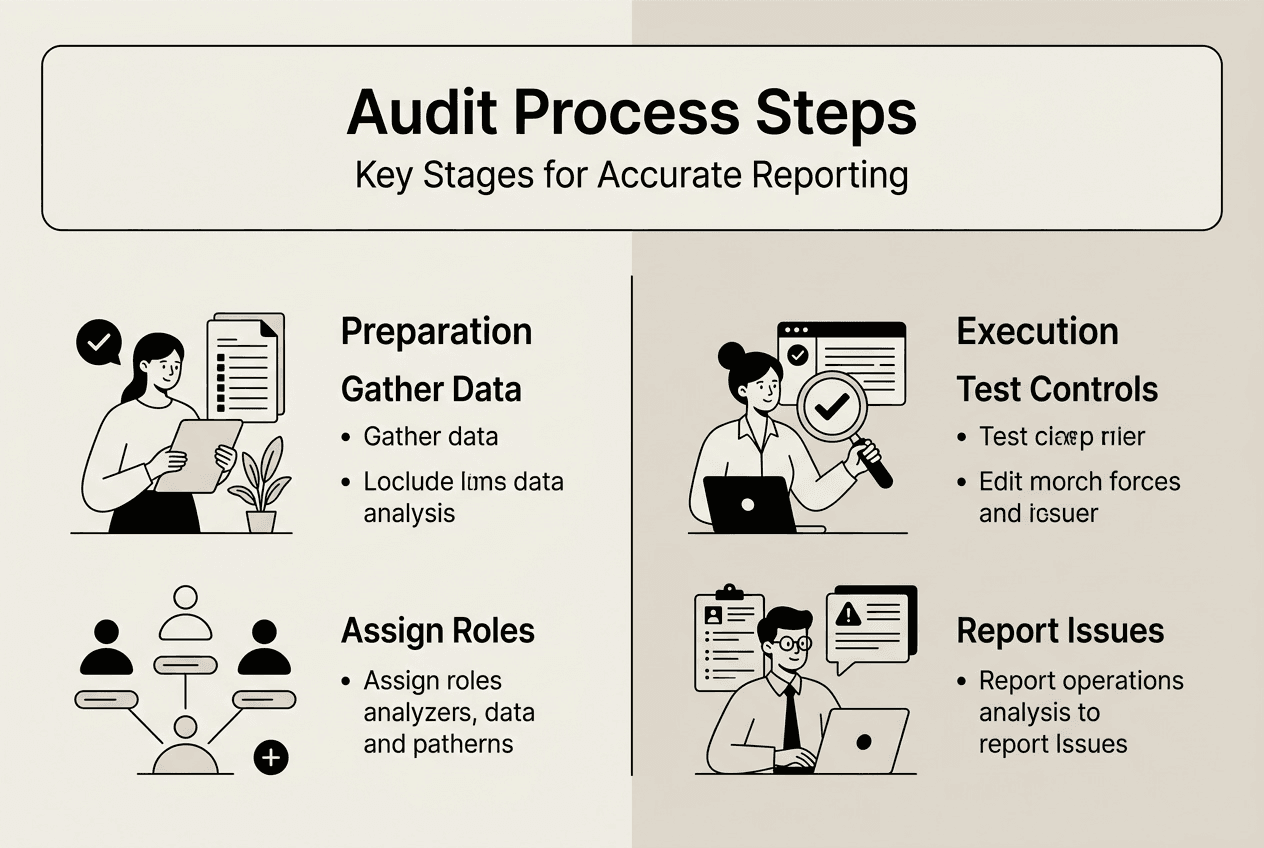
Audit execution begins with identifying key risk areas that demand scrutiny. Focus on accruals, debt and lease accounting, revenue recognition, and expense classification. These areas generate the most audit findings in mid-market companies. Every analysis must lead to a risk or confirmation, so document your risk assessment methodology and ensure your testing procedures address each identified risk.
Perform systematic reconciliations using this sequence:
- Extract data from source systems (ERP, billing, payroll) into your audit workspace
- Run automated matching algorithms to identify discrepancies between systems
- Investigate variances exceeding your materiality threshold (typically 1-5% depending on account size)
- Document explanations and corrective actions for each material difference
- Obtain management sign-off on reconciled balances before proceeding
Automated tools accelerate this process by flagging exceptions instantly. Instead of manually comparing thousands of transactions, your system highlights the 50 items that need attention. This targeted approach cuts reconciliation time from weeks to days.
An accounts payable audit is a structured review to confirm liabilities are accurate, authorized, and recorded properly. Your AP audit should verify:
- All invoices match approved purchase orders and receiving documents
- Payment terms align with contract terms and vendor agreements
- Accruals for goods received but not invoiced are complete and accurate
- Vendor statements reconcile to your AP subledger without unexplained differences
| Audit Step | Purpose | Key Controls |
|---|---|---|
| Risk identification | Prioritize high-risk accounts | Historical error analysis, materiality assessment |
| Data reconciliation | Verify accuracy across systems | Automated matching, variance investigation |
| Control testing | Confirm processes operate effectively | Sample transaction testing, approval verification |
| Issue escalation | Address exceptions promptly | Defined thresholds, management review |
Escalate anomalies according to clear governance rules. Define materiality thresholds for different account types and establish escalation paths for issues exceeding those limits. A $500 variance in office supplies may not warrant CFO attention, but a $50,000 discrepancy in revenue recognition demands immediate investigation. Your escalation protocol should specify who reviews what, when they review it, and what documentation is required.
Pro Tip: Use audit trails and embedded controls to eliminate manual reconstruction. When your systems automatically log every transaction change, approval, and reconciliation, you answer auditor questions in minutes instead of hours.
Operations and financial data audit processes benefit from integrated technology that connects operational metrics to financial results. When your production data, inventory movements, and sales transactions flow automatically into your financial systems, reconciliation becomes a validation exercise rather than a detective mission. Financial reporting automation methods enable this seamless integration, reducing manual effort and improving accuracy.
Verifying and closing the audit: review, reporting, and follow-up
Verification starts before official audits begin. Mock audits conducted 2-4 weeks before fieldwork uncover up to 80% of issues, giving your team time to fix problems before auditors arrive. Schedule internal reviews that mirror external audit procedures. Test the same controls, sample the same transactions, and challenge the same assumptions auditors will examine. This proactive approach transforms surprises into solved problems.
Adopt a review-first approach to catch errors before final reconciliations. Review-first policies prevent late discovery of errors and reduce rework by identifying issues when they're easiest to fix. Instead of reconciling first and reviewing later, have a second set of eyes verify data accuracy before reconciliation begins. This simple process change cuts reconciliation errors by 15% and prevents the costly rework that derails close schedules.
Leverage AI reconciliation software to accelerate preparation. AI-powered reconciliation tools reduce audit preparation time by up to 70% by automating matching, flagging exceptions, and suggesting resolutions based on historical patterns. These tools learn from your reconciliation decisions, becoming more accurate over time. What once took days of manual comparison now happens in hours, freeing your team to focus on analysis and decision support.
Standardize your financial close checklist to ensure consistency:
- Complete all subledger reconciliations before consolidation
- Review and approve all journal entries with supporting documentation
- Verify accruals and deferrals align with contract terms and revenue recognition policies
- Confirm intercompany transactions eliminate properly in consolidated statements
- Run variance analysis comparing actual results to budget and prior periods
| Verification Activity | Frequency | Responsible Party |
|---|---|---|
| Mock audit | 2-4 weeks before fieldwork | Internal audit or controller |
| Reconciliation review | Before final close | Accounting manager |
| Control testing | Quarterly | Finance operations team |
| Documentation check | Monthly | Department heads |
Document findings, corrective actions, and follow-ups meticulously. Your audit trail should show what issues you discovered, how you resolved them, and what controls you implemented to prevent recurrence. This documentation serves two purposes: it satisfies auditor requests for evidence, and it creates a knowledge base for continuous improvement.
Pro Tip: Build a centralized repository for audit documentation that everyone can access. Cloud-based platforms ensure your team and auditors can find supporting documents instantly, eliminating the email chains and file searches that waste time during fieldwork.
Month-end close acceleration techniques complement your audit verification process by establishing routines that maintain data accuracy throughout the period. When your close process is efficient and controlled, audit preparation becomes a natural extension of your monthly workflow rather than a disruptive event.
Transform your audit process with Lole Works
Your finance team deserves better than spreadsheet chaos and manual reconciliation marathons. Lole Works specializes in AI and BI infrastructure for private equity and mid-market companies, delivering solutions that unify data sources and automate reporting workflows. We help you build the single source of truth that makes audits straightforward instead of stressful.

Our operations data audit solutions integrate your ERP, billing, and operational systems into cohesive reporting infrastructure. We implement embedded controls, automated reconciliations, and real-time dashboards that give you continuous visibility into financial performance. When audit season arrives, your data is already verified, reconciled, and documented. Our reporting and BI services transform audit preparation from a quarterly crisis into a routine validation exercise, cutting preparation time by up to 70% while improving accuracy and control.
FAQ
What is an operations data audit and why is it important?
An operations data audit systematically reviews your financial and operational data processes to verify accuracy, completeness, and control effectiveness. It's important because it prevents costly errors, detects fraud early, and ensures your financial reports support confident decision-making. Regular audits also satisfy investor and lender requirements for reliable financial information.
How can technology improve the operations data audit process?
Technology automates reconciliations, generates reliable audit trails, and flags exceptions in real time. AI-powered tools can reduce audit preparation time by up to 70% by learning from historical patterns and suggesting resolutions. Integrated systems eliminate manual data transfers and ensure consistency across all reports, making verification faster and more accurate.
What are the most common audit risks to watch for in mid-market companies?
Recurring issues include incomplete accruals, incorrect debt and lease accounting, inconsistent expense recognition, and weak revenue recognition controls. Human error causes 41% of inaccurate reporting, often stemming from manual processes and disconnected systems. Focus your audit attention on these high-risk areas to catch problems before auditors do.
What is a review-first approach and how does it benefit audits?
Review-first means verifying data accuracy before you begin reconciliation, catching errors when they're easiest to fix. This approach reduces reconciliation errors by 15% and prevents the costly rework that occurs when issues surface during final close. Having a second set of eyes review data early ensures your reconciliations start with clean inputs, accelerating the entire process.